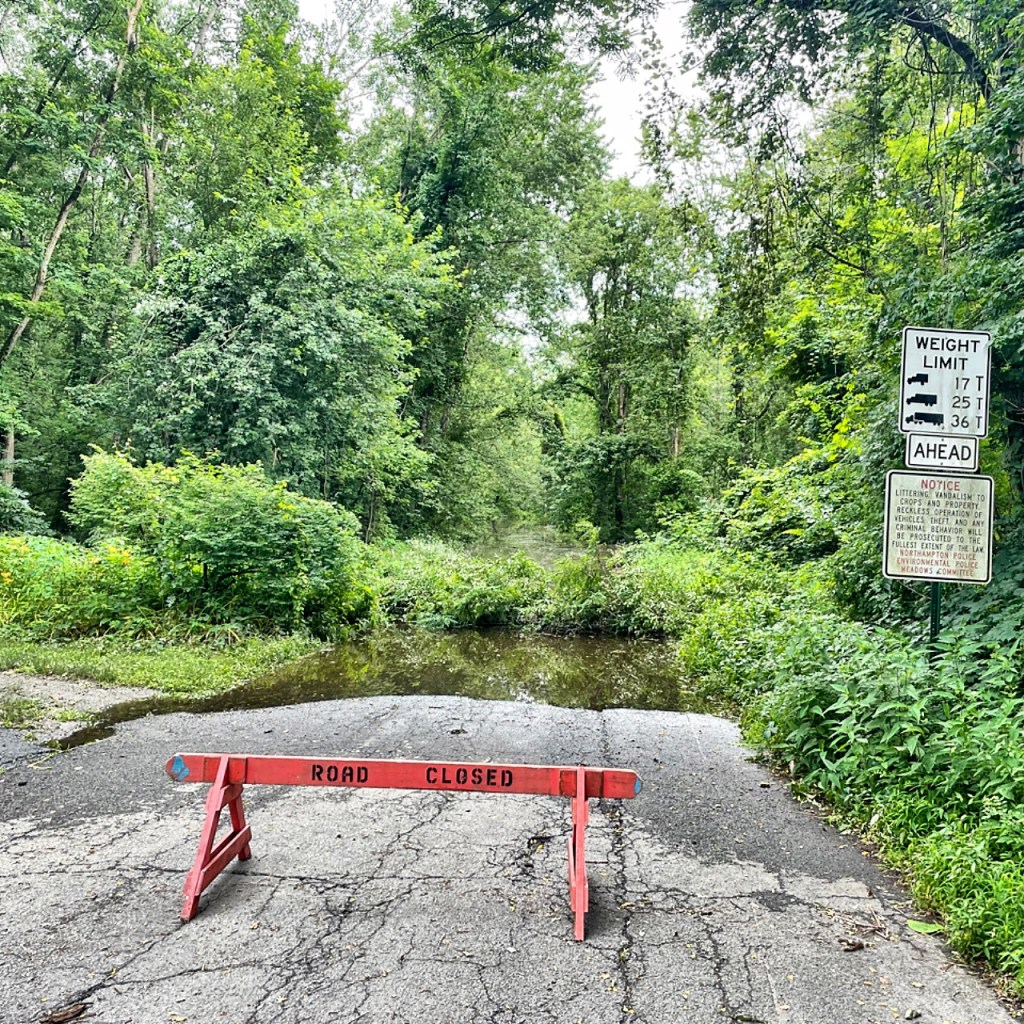
[December 2023] Floods are not only water. Floods can also be memories, mistakes, and miracles: we consider ourselves overflowing with each of these from time to time. Recently I’ve returned from my first plane travel in five years. I am awash in the experience of arriving, carrying the sunshine of where I have just been into afternoons of mid-winter flood watch. I am reminded how, some months ago, just a few weeks after the smoke-drenched sky of last summer’s wildfire season curtained us completely, the river here dramatically leapt its banks. I found myself flooded with emotion: relief at no longer being in drought, grief at the damage of rushing tides in places formerly dry. The path to our local firefly spot was entirely submerged.
As I watched the water move, a few crumbs from my snack fell into the mucky swirl. Small fish poked up through the opaque surface, nipped at bits of cracker, swam around top railing of stairs to nowhere. Or, rather, stairs which led to what used to be a dock a long flight down. The animal of me was met by the animals the fish are, a moment that was, perhaps, remarkable for nothing other than its normalcy amidst calamity. If I didn’t know what I know, I would have existed in joyful presence, watching them nibble. I remember how I craved the calm of simply observing fish in water, yet could not for a moment pretend that’s all there was.
I returned home from the river. The turkeys were congregating in my neighbor’s yard. A large crowd of deer gathered behind the next house. One silver fox darted across a driveway. Such things had never happened in this neighborhood as long as I’ve lived here. The creatures were all driven uphill from burrows in once-meadows by the oxbow, fields turned to lakes.
In tracking through what my brain has retained of that one afternoon of recent flood and what it did to nearby Beings, my words inevitably also traverse months, years, decades, centuries — what it means to notice, which is to say love, a place. May this flow of story tune us in to the oft-forgotten truth that our bodies are always in constellation and conversation with the bodies of our fellow animals.
This, then, is the story I want to tell: how we are all ordinary animals, living through extraordinary times. How the heft of my family’s relationships with land across generations moves, eddies, swishes through my veins and bones. How that makes me reach my fingers towards birds as they squeeze their way through the sky, somewhere between burning and drowning. We are all suspended together, here, somewhere between burning and drowning.
Who am I in this story of the miraculous normal and the normal miraculous which I am called to tell? One set of biological grandparents were farmers; they were not separate from the sacred dark dirt, sweet maples, rain showers on rows of vegetables. The other set were traveling salespeople; they saw rivers and plains from the windows of planes. I learned to love our planet by staying still and by staying in motion, by holding seeming opposites up to the light and finding the place where they blend into one.
Years ago, I sat at the edge of Great Falls on the Maryland side, Piscataway Land (far from the Nipmuc Pocumtuc area where I find myself now). I’d hopped a fence, or rolled my lean runner’s body through the dust under the bottom row of chain links. I don’t remember which, but in any case I wasn’t supposed to be quite there. Yet I trusted my intuition, leaned in to my read of the natural world — and here I am to tell the tale. Shortly after, I wrote this:
Falls expand and contract all the time. Frequently they swell.
Frequently they recede.
Across the way I can see: a tennis ball, three detergent bottles, two soda cans, a tire, a buoy, a mess of sticks and branches. All this trash amongst the tree carcasses breaks my heart.
Just beside me: flood line that is not too distant, not too recent. Skull of someone, maybe deer?
To be here on these rocks is to be at risk. Falls expand, contract, swell, recede.
But to be at the mercy of water is to be alive.
In the end, it swallows us all.
When these recent floods swallowed us here, I anticipated the algae, even the dead frogs in the road. I was not surprised by the drowned worms, the pungent stench, nor the herds of mosquitos. What I didn’t expect – despite my ages ago experience of the flood line hundreds of miles south – was how when the water receded the mud dust remained in a thin tan varnish on the brush and trees above my head, a stark coat drawn from the point the water reached all the way down to the ground. The visual was bizarre. Like everything was covered in nine feet of cheap milk chocolate. It seemed yet another apocalypse. Or an art installation. Or maybe, with a bit of luck and some serious work, an opportunity to be creative. To see and paint the world anew.
When these recent floods swallowed us here, what happened to the rows of crops? The twinkling fireflies? The bees, those tiny buzzing bodies who collectively labor to free any of their kin who have become accidentally trapped in honey? We all donated to the local farms, as much as we could, and I imagined us in the hive of our town all working to be okay together. Friends, this essay, then, is a nod not only to floods but to the mutual aid it takes to survive them. For the actual logistics of the mutual aid, but also the hope of it which is just as valuable if not more valuable than the tangibles.
Friends, from there it is an obvious step to say: I cannot for a moment pretend that’s all there is, so this essay calls out for ceasefire. Nothing worth reading right now can be written without writing that. To stand strong with a commitment to nuance and a belief that no one — no one — deserves a violent death. To love the world is to grieve the harm, and to grieve the harm is to take action to stop it. To keep building towards a world that is liveable, no matter what. Our bodies in honest conversation with all our fellow bodies. Not an easy thing, but the only thing there is. We are amidst so many horrific floods, yet what there is to do is just – trudge, ache, dance, shatter, break, pray, play, laugh, crawl, stumble, care, tender, pleasure our way to what is beyond. Keep going. Let us keep going. Just that. That we might free one another and ourselves. That we might find out what is after the floods.
 ej seibert
4 responses to “Is There Such a Thing as After the Floods?”
Love the layers and levels of this and that it turns on those final thoughts of buidling a world that is livable for all. Thank you.
LikeLiked by 1 person
Thank you so much, Jan, for reading — and for the kind words!
LikeLike
I am well aware of the lines a flood leaves behind. My village was devastated 13 years ago, and the memories can be summoned by a scent of mud, of a sepia sky and the milk chocolate that still dusts and defines walls, where the Susquehanna breached her banks.
Thank you.
LikeLiked by 1 person
Thank you for reading, Susan, and for this comment. Deeply feeling the relevance right now, today, thinking of all those impacted…
LikeLike