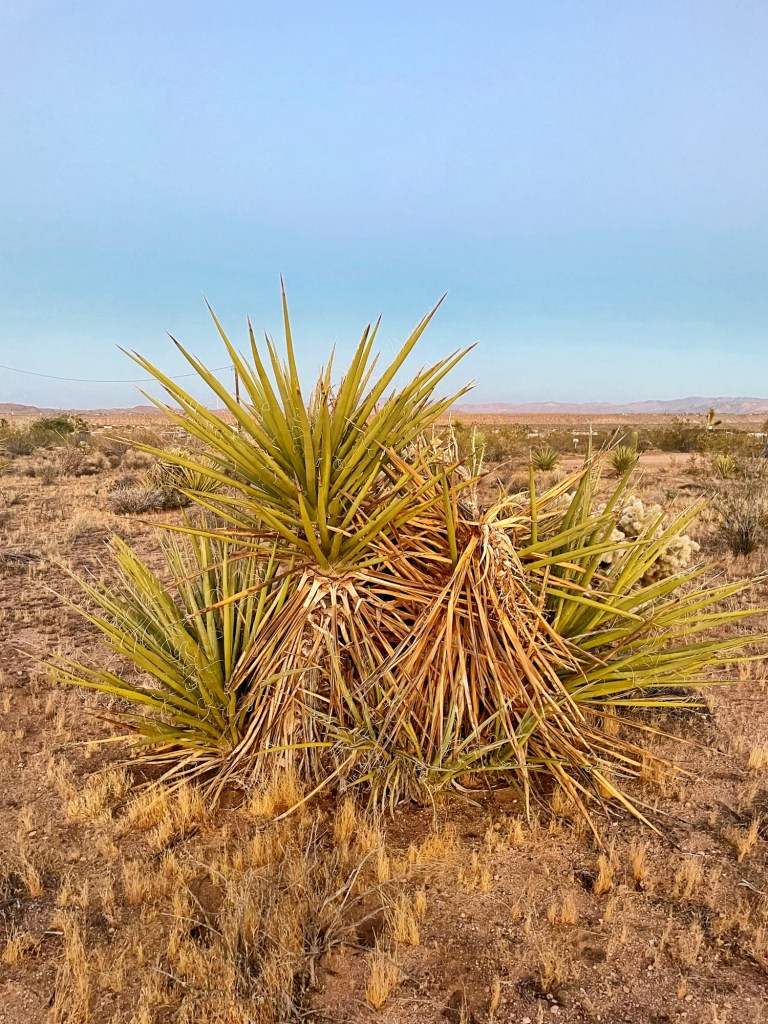
[July 2024] Even my words are sprinkled with sand here. It sifts through everything, swishing swirls of air holding tiny grains aloft. I am in Yucca Valley again. This past January I traveled here for the first time since family members moved, initially from L.A. to Joshua Tree and then from that lower plain to this higher desert. Their house is now at nearly 4000 feet. From the frenetic city of angels to a vast enveloping quiet. There’s a clarity I find in this place which lends itself to prismatic reflection: sun off stony hills, feelings and thoughts through a slightly-slowed mind.
As I arrived to Palm Springs back at the beginning of this year, during my previous trip, I happened to be reading Rebecca Solnit’s The Faraway Nearby. Just as I caught the first glimpse of yucca out the plane window, I came upon the page which has this line across the bottom: “The yucca survives only by the pollination efforts of this moth” (68). I smiled at the meta moment. As I departed a week later, I came upon the chapter called “Flight” while sitting in the airport waiting to board. I attune to synchronicity; I believe it surrounds all of us, though I have made a particular practice of paying attention. Sometimes this companioning happens and astounds me, comforts me. These are the gifts of noticing.
That same winter day I read “Flight” and departed, just after I stepped out of the plane on the East coast, desert dust still on my boots as they hit icy ground, I wrote in my journal:
Have made a covenant with the desert. I know the words I spoke but don’t suppose I know exactly what it means. “I’ll return. I’ll keep writing.” Something like that. Though it may seem peculiar to say I’ve promised the sand I’ll continue the work of words, there you have it.
I tend to keep my commitments, so now it is July and I am back. Of course, I also continue the work of words… or, perhaps, the work of words continues me. Last week, just before this current visit, my friend Clare and I attended a powerful art show opening and book reading by Chelsea Granger at Looky Here Gallery in Greenfield, MA. Before we went inside, Clare and I sat on the curb catching up. She asked how I was. I told her it had been a strange but overall positive week. She leaned in, listening. I told her how the word kismet had been spoken by four separate people in four separate conversations in a span of two days. I am a writer. I have focused on linguistics, discourse analysis, poetry. Which is to say: I study word behavior and this one was acting odd.
I hadn’t heard it in years and admittedly had to refresh my brain by looking it up. The first time someone uttered it that week, I did not seek its definition, nor the second or third. The fourth time, how could I not? It means something like fate, something like destiny. Merriam Webster declares that it came from the Arabic word qisma, meaning “portion or lot,” and was adopted into English during the 1800s. Fancy that.
After the reading, Clare and I walked around town. We ran into my friend Christina – someone I dated years ago – out with her wife Karen, and said a very pleasant hello. As we continued past them, Clare talked about her recent exploration in dating more than one person simultaneously, and shared that she dislikes the term relationship anarchy though it is the ethos which most resonates. We agreed that phrase unfortunately communicates chaos, and chaos is not what Clare is about. We started tossing out potential alternatives. Relationship fluid? Overused. Relationship flexible? Sounds like a diet. Relationship ease? That’s a feeling, not a style, state, or framework. There was a beat during which neither of us spoke. Then I found myself saying: relationship kismet! We laughed, then acknowledged it is actually fitting for the concept of allowing each connection to find the truth of what it is.
Though I have a hard time believing anything is original, given the brilliance of so many humans across time, perhaps we coined a new phrase that night. Relationship Kismet, a term which can include me – someone with a multitude of ferociously loving friendships, though I tend towards romantic/sexual monogamy. And a term which can include Clare.
Allow me to note that I know some interpret my tendency towards monogamy as a moral failing, while others interpret it as evidence of a strong moral compass. It is neither. When I feel a question in the air to the tune of why, I often say that, for me, as someone who doesn’t really experience jealousy, my choice is about germs and time management; this statement generally elicits laughter as intended. That’s shorthand, a distilled summary. More completely, it is simply an expression of what’s true in my Being, how I feel most at home in my intimate relational world. Those who choose otherwise are, similarly, resting into their authenticity.
Relationship Kismet can also include, well, yucca and word behavior, the thread between a book in my hand and the vista seen from above as a plane lands. The larger web woven between language, place, and existence. Synchronicity, when the underlying interconnectedness of all things is briefly revealed. Everything is a matter of relationship – not just romance, not just human-to-human bonds.
As I drove home from Greenfield that night, I put my entire music library on shuffle – it is about 3000 songs. Higher Love came on not once, but twice. That was the song Christina had decided would be “our song” – if we had stayed together as a couple, which we did not. But we have crafted a warm acquaintanceship. Sometimes Higher Love is friendship. Sometimes Higher Love is simply letting what’s true be true.
Chelsea and I grew up in the same small town. We were a couple of years apart in school. I remember her from Ms. Centore’s and Ms. Krawczyk’s painting and drawing classes, long before her art took off and spread like the plants she so beautifully illustrates in the Dirt Gems deck. She doesn’t remember me. She says this is because she’s likely blocked out a lot of that time from her memory. I can understand this. The land there is beautiful. The people and politics are often harsh. Yet that harshness is part of what shaped my softness. It was medicine to see those paintings, to hear those words on grief and loss and joy vibrating through the gallery space. Not just for the creations themselves, but because they came from someone whose path is perhaps as unlikely as mine.
Though I have always adored learning, I used to find the process of travel unsettling. It felt betwixt, between, liminal, a flavor perhaps too reminiscent of moments of groundlessness during childhood. A childhood full of trials and pain, if also of blessings and love. A childhood shared with one blood sibling (though I count many others as adoptive and kinship family). This blood sibling lives now in California, on a coast which I hesitate to call opposite to the one where we grew up; the miles stretch across terrain changes, though ultimately it’s the same land. I travel to see him and his partner, his partner’s whole extended family, and many other beloveds. This temporary displacement, this movement, is now a space in which I find poetry.
Perhaps the fragmentation of grammar properly lives in a state of groundlessness. And groundlessness is not quite appealing, but interesting, when, and only when, one has faith in solid ground. It’s just in the last few years I have truly found that kind of faith. Yes, amidst the beautiful burning world, the constantly shattering world, the endlessly impermanent world, I somehow gained the deep emotional vocabulary of constancy.
After the babies have gone to bed and the sunset has cooled the dry air to just under a hundred degrees Fahrenheit, we sit on my sibling’s patio and talk. He answers questions I asked years ago, which he wasn’t ready to speak to then, but which he is eager to revisit. About what his world was like in those first couple decades of life, especially after I moved out of our parents’ house. My first year undergrad roommate Ariel joins. Some others in our dorm called Ariel “California,” since she grew up in L.A. Though we keep in touch, we haven’t been face to face in over a decade. We uncover more uncanny similarities between her family and mine, right down to the fact that both of our brothers have two rabbits. Plus things we didn’t know how to talk about when we met over two decades ago. Some of these things hurt, yet saying them aloud is balm. We can all smell the smoke of wildfires as we talk. Yucca survives in this climate, thrives in it.
Years ago I read a few Mary Oliver lines over and over, the ones from Dogfish about “want[ing] the past to go away,” and “mostly… want[ing] to be kind.” Demons don’t often agree to be left behind. Yet perched at the edge of the desert, I see the ways my sibling and I both decided to release the punishment of it all, even if the memories remain. To step out of the energy of those stories like old, faded garments. Weave the wisdom gleaned into a new style of Being beyond. Finding solid ground and letting go. The two are so much more intertwined than my younger self could fathom. Certainly there is kindness to oneself and to others in this process, the capacity to expand belonging, and gratitude for the relationship kismet found via growth. I might even call it healing.
Some describe the desert as harsh. I don’t experience it that way. To me it feels more like a wide open palm, cupping my tiny awed self. I wonder if what people mean is something like: the desert reminds me of my own thirst, my need for water, the fact that the fluid in my body – and therefore my life itself – is finite. To me, that isn’t harsh. It’s natural. Obvious. Honest.
Everything has a way of being what it is. We can choose to resist, or to accept. As the summer sand whisks me clean, my heart prays: may I be hardy as the yucca and may I always keep aligning, re-presencing to what is real.
 ej seibert